Showing posts with label We Have a Revenue Problem. Show all posts
Showing posts with label We Have a Revenue Problem. Show all posts
Tuesday, December 17, 2013
More Crazy Numbers
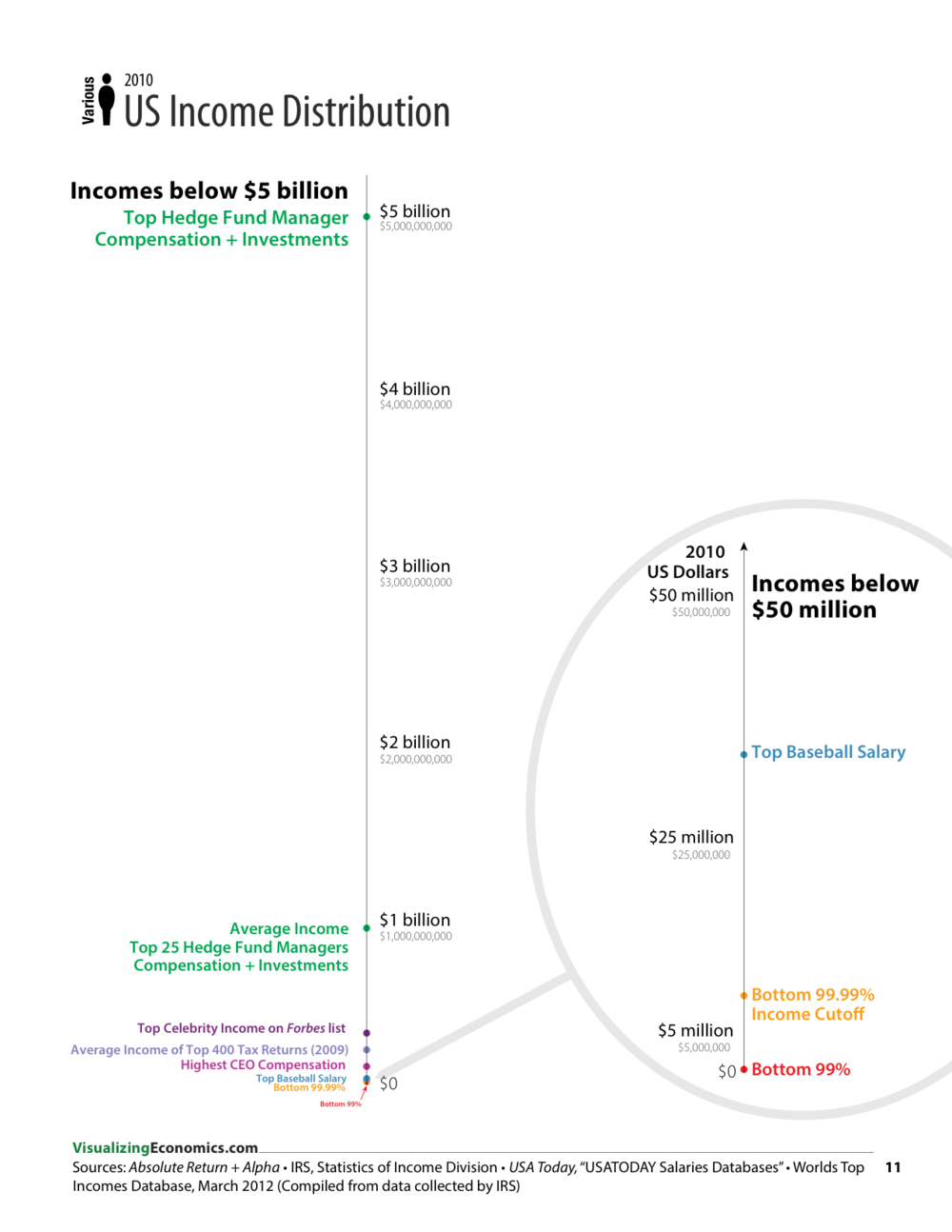
Ritholtz features a couple of great charts on income inequality. This one relates to the video in the previous post:
 $5 billion in a year? That is so fucking ridiculous that I just don't have words to describe it.

Monday, December 2, 2013
Germany Also Shorts Infrastructure Spending
NYT (h/t nc links):
$9.7 billion a year? That sounds like nothing compared to what ASCE thinks the U.S. needs to spend ($3.6 trillion by 2020. Admittedly, ASCE isn't exactly a neutral observer). But still, Germany has about 25% of the number of people as the U.S., and spends a tiny fraction of what the U.S. does on defense spending, so $9.7 billion a year is practically nothing. To put it in perspective, the Brent Spence Bridge replacement, carrying I-75 across the Ohio River from Cincinnati to Northern Kentucky, is expected to cost $2.5 billion by itself. Anyway, at least we aren't the only extremely short-sighted developed nation.Germany was once known for its superfast autobahns, efficient industry and ability to rally public resources for big projects, like integration with the former East Germany. But more recently, it has been forced to confront a somewhat uncharacteristic problem: Its infrastructure — roads, bridges, train tracks, waterways and the like — is aging in a way that experts say could undermine its economic growth for years to come.As it has been preaching austerity to its neighbors, Germany itself has kept a tight rein on spending at home. Now critics abroad, including the European Union and the United States, are pressing it to do more to stimulate its own economy, and Chancellor Angela Merkel’s likely partners in a new coalition government, the left-leaning Social Democrats, are seeking more money for a variety of domestic programs.A good place to start plowing money into, many experts say, is the nation’s physical underpinnings. A government-appointed commission recently concluded that it needed to spend 7.2 billion euros a year, or $9.7 billion, for the next 15 years — roughly 70 percent more than it spends now — just to get existing infrastructure back into shape. Others say that even more is needed for schools, for instance, and for extending fiber optic cables to less populated areas.
Sunday, December 1, 2013
Job Creators? Not Quite

"Rich people create the jobs."Lots of people don't believe this, which seems obvious to me. Income inequality cuts a large percentage of people out of being able to fully support the economy, while a smaller percentage of the population has way more money than they could ever use to benefit the economy. Why have we had so many bubbles? Mainly because all the excess wealth is being employed in speculating for greater gains. All those dollars are chasing a finite number of potential investments. If you are really concerned about a balanced budget, you would support taxing more of that wealth, or creating regulations to ensure that more of the national income went to labor. Most "budget hawks" are opposed to both.
Specifically, by starting and directing America's companies, entrepreneurs and rich investors create the jobs that sustain everyone else.
This statement is usually invoked to justify cutting taxes on entrepreneurs and investors. If only we reduce those taxes and regulations, the story goes, entrepreneurs and investors can be incented to build more companies and create more jobs.
This argument ignores the fact that taxes on entrepreneurs and investors are already historically low, even after this year's modest increases. And it ignores the assertions of many investors and entrepreneurs (like me) that they would work just as hard to build companies even if taxes were higher.
But, more importantly, this argument perpetuates a myth that some well-off Americans use to justify today's record inequality — the idea that rich people create the jobs.Entrepreneurs and investors like me actually don't create the jobs -- not sustainable ones, anyway.
Yes, we can create jobs temporarily, by starting companies and funding losses for a while. And, yes, we are a necessary part of the economy's job-creation engine. But to suggest that we alone are responsible for the jobs that sustain the other 300 million Americans is the height of self-importance and delusion.
So, if rich people do not create the jobs, what does?
A healthy economic ecosystem — one in which most participants (especially the middle class) have plenty of money to spend.
Over the last couple of years, a rich investor and entrepreneur named Nick Hanauer has annoyed all manner of other rich investors and entrepreneurs by explaining this in detail...
What creates a company's jobs, Hanauer explains, is a healthy economic ecosystem surrounding the company, which starts with the company's customers.
The company's customers buy the company's products. This, in turn, channels money to the company and allows the the company to hire employees to produce, sell, and service those products. If the company's customers and potential customers go broke, the demand for the company's products will collapse. And the company's jobs will disappear, regardless of what the entrepreneurs or investors do.
Thursday, November 28, 2013
Indiana Police Chief Gets Tasered For Fundraiser
AP:
Knightstown police Chief Danny Baker has used pig roasts and golf tournaments to augment his department's shrinking budget, but badly in need of $9,000 for a new squad car, he's reprising his most shocking fundraising approach to date: getting shot by a stun gun.Why is their funding drying up? For that, they can thank the Republicans they keep voting in office. Anyway, here's what he raised:
The jocular 63-year-old chief and another Knightstown official were planning to have a detective shoot them with a Taser at a free event Wednesday night in the middle school gym in their small eastern Indiana town. Spectators — who Baker hopes feel compelled to donate — will get a firsthand look at how 50,000 volts of low-amp electricity affects the human body.
"It's a shame we have to go to the extent of having fundraisers and getting electrified and so forth, but with small-town budgets you have to do something to get by," said Baker, a lifelong Knightstown resident who has been in law enforcement for 35 years.
Many rural communities like Knightstown, a mile-square town of 2,100 about 25 miles east of Indianapolis, are having to become inventive to fund needed services, said Brian Depew, executive director of the Center for Rural Affairs, an advocacy group based in Lyons, Neb.
Depew said federal farm bill funding for rural development has fallen by a third since 2003, leaving less money for police cars and other necessities in an era of shrinking rural populations and tax bases.
Some communities have taken to putting ads on cruisers, while others, like Knightstown, are relying on donations for help.
A police chief of a small eastern Indiana town who was shot by a stun gun at fundraising event to buy a new squad car says he raised about $800 in cash and received a $25,000 pledge from a Texas company.This isn't the way to run a country.
Knightstown Police Chief Danny Baker says he's been receiving calls from all over the country and expects to collect more money. His goal was to raise $9,000 so the town of about 2,100 people about 25 miles east of Indianapolis could lease a new squad car. He says he might be able to get a second car.
Tuesday, November 26, 2013
More Catholic Than I Think?
It looks like the Pope and I agree on a few things:
Pope Francis is once again shaking things up in the Catholic Church. On Tuesday, he issued his first “apostolic exhortation,” declaring a new enemy for the Catholic Church: modern capitalism. “Some people continue to defend trickle-down theories which assume that economic growth, encouraged by a free market, will inevitably succeed in bringing about greater justice and inclusiveness in the world,” he wrote. “This opinion, which has never been confirmed by the facts, expresses a crude and naive trust in the goodness of those wielding economic power and in the sacralized workings of the prevailing economic system.”This will burn up the conservatives. But shit, who can claim that "trickle down economics" works? We've got over thirty years of it not working, and we keep being told that it will work with one more tax cut. Bullshit. Taxes should go up on the very high end of the income range. You don't have to be the Vicar of Christ to figure that shit out, but I'm glad he's out there pointing out the shortcomings of our supposedly capitalist economy.
He couldn't be much clearer. The pope has taken a firm political stance against right-leaning, pro-free market economic policies, and his condemnation appears to be largely pointed at Europe and the United States. His explicit reference to “trickle-down” economic policies—the hallmark of Ronald Reagan, Margaret Thatcher, and their political successors—is just the beginning: Throughout 224 pages on the future of the Church, he condemns income inequality, “the culture of prosperity,” and “a financial system which rules rather than serves.”
Taken in the context of the last half-century of Roman Catholicism, this is a radical move. Fifty years ago, around the time of the Second Vatican Council, Church leaders quietly declared a very different economic enemy: communism. But Pope Francis’s communitarian, populist message shows just how far the Church has shifted in five decades—and how thoroughly capitalism has displaced communism as a monolithic political philosophy.
Monday, November 18, 2013
Cassini or Curiosity?
NASA considers where in its robotic exploration budget to cut:
This year NASA received $16.9 billion, which may sound like a lot but, once adjusted for inflation, is roughly what the agency got back in 1986. Just $1.27 billion of that budget goes into funding all robotic exploration in the solar system. And most space policy experts don’t see that number going up anytime in the near future. In 2014, NASA will put many of its robotic missions through what’s known as a senior review. Administrators will have to decide which of its missions will yield the highest scientific return and may recommend canceling some of them.You know, to come up with that $60 million, maybe we could trim back the dividend tax cut, which costs the government over $20 billion a year. But hey, who needs science research when super rich folks need lower tax rates on unearned income than what working stiffs pay on earned income.
And that’s where some sad calculus comes in.
“We have two very expensive flagship missions, Cassini and Curiosity,” said NASA’s planetary science director Jim Green, speaking to one of the agency’s advisory councils on Nov. 5. “So, this particular competition we’ll have to do very carefully.”ou wouldn’t think the Cassini spacecraft, in orbit around Saturn since 2004, was in trouble. It has lately been beaming back incredible data about the planet’s rings and moons. A recent image from the mission (above) showing Earth, Venus, and Mars from Saturn was widely shared on the internet and even landed on the front page of the New York Times last week.
But NASA seems to want to focus its dwindling energy on Mars.....Most in the planetary science community would bet that in a head-to-head competition, Cassini loses. That would be a shame. Cassini has already been an incredible mission, and scientists estimate it has at least four more years of life left in it. Cassini’s operating budget is about $60 million per year while Curiosity’s runs to roughly $50 million. That’s about what the Department of Defense has budgeted for 3-D printer research and is less than half of what it’s estimated to spend maintaining its golf courses. The Cassini mission has already cost $3.26 billion to launch and operate.
Thursday, October 31, 2013
Bill Gross Not Talking His Book
At least for once:
Bill Gross is feeling guilty about being among the wealthiest people in America. That's why he thinks that he and other filthy rich members of the 1% should pay more in taxes.I've been critical of Gross at times, but in this case, he gets it. Today's inequality is staggering, and it can't last. There are two options, raise wages or raise taxes. I'd be happier than hell to see this be handled by the private sector, but I won't hold my breath.
"Having gotten rich at the expense of labor, the guilt sets in and I begin to feel sorry for the less well-off," writes Gross, co-founder of investment firm Pimco and manager of the biggest bond fund in the world, in the opening of his latest monthly investment letter.
Gross usually devotes his outlook pieces to discussions of the bond market. And they are often littered with pop culture references. He didn't disappoint this month.
He compared those who complain about paying a greater percentage of their wealth in taxes to the Disney (DIS, Fortune 500) character Scrooge McDuck.
"It's time to kick out and share some of your good fortune by paying higher taxes and reforming them to favor economic growth and labor, as opposed to corporate profits and individual gazillions," Gross wrote.
Gross is at the very top of the ultra-rich group he is talking about. Forbes estimates his net worth at $2.2 billion, which would put him in the top 0.01%.
Gross said he and other top 1% earners need to recognize that they have had the "privilege of riding the credit wave and a credit boom for the past three decades. Paraphrasing President Obama's "you didn't build that" comment from the 2012 campaign, Gross reminds the rich "you did not create that wave. You rode it."
Thursday, October 24, 2013
Why We Need Higher Marginal Rates
The Guardian:
In the United States, the share of total pre-tax income accruing to the top 1% has more than doubled, from less than 10% in the 1970s to over 20% today (pdf). A similar pattern is true of other English-speaking countries. Contrary to the widely-held view, however, globalisation and new technologies are not to blame. Other OECD countries, such as those in continental Europe, or Japan have seen far less concentration of income among the mega rich.I was just trying to make this point on Tuesday night to a couple of Tea Party Libertarian types I went to high school with. They looked at me like I had 3 heads. To me, it makes pretty damn good sense, but it seems most folks around here just think it is the worst idea in the world. My point is that if something doesn't change, the so-called defenders of Capitalism will end up being its destroyers. With widening inequality, somethings gotta give. I'd much rather it be low tax rates on top incomes that go away than society as we know it.
At the same time, top income tax rates on upper income earners have declined significantly since the 1970s in many OECD countries – again, particularly in English-speaking ones. For example, top marginal income tax rates in the United States or the United Kingdom were above 70% in the 1970s, before the Reagan and Thatcher revolutions drastically cut them by 40 percentage points within a decade.
At a time when most OECD countries face large deficits and debt burdens, a crucial public policy question is whether governments should tax high earners more. The potential tax revenue at stake is now very large.
For example, doubling the average US individual income tax rate on the top 1% income earners from the current 22.5% level to 45% would increase tax revenue by 2.7% of GDP per year – as much as letting all of the Bush tax cuts expire (only a small fraction of them lapsed in January 2013). But of course, this simple calculation is static: such a large increase in taxes may well affect the economic behaviour of the rich and the income they report pre-tax, the broader economy and, ultimately, the tax revenue generated. In recent research, we analyse this issue both conceptually and empirically using international evidence on top incomes and top tax rates since the 1970s.
There is a strong correlation between the reductions in top tax rates and the increases in top 1% pre-tax income shares, for the period from 1975-79 to 2004-08, across 18 OECD countries for which top income share information is available. For example, the United States experienced a 35 percentage-point reduction in its top income tax rate and a very large ten percentage-point increase in its top 1% pre-tax income share. By contrast, France or Germany saw very little change in their top tax rates and their top 1% income shares during the same period.
Wednesday, October 9, 2013
Gosh Darn (edited), Real Politics is Hard
I was just hanging out with a bunch of folks I really like and respect. Somebody (not me) made some comment that I would describe as straight from Fox News. So I tried as best as I could (I swear) to explain why I thought that position was understandable, but ultimately misguided, and suddenly I was fucking Karl Marx risen from the dead. I laid out all the information I could muster, and when people didn't believe what I said, I told them that seriously, they could trust the numbers I put out there. The response I got was that I may have the numbers, but they understood the reality. I tried to explain that they understood the anecdote they lived or heard about, but that the numbers gave a better explanation of realtiy. I got 0 to 1 converts. Actually, I got zero converts. That is extremely frustrating.
Sunday, October 6, 2013
The Reign of Morons
Charles Pierce:
I've worked really hard in conversations with people since then to explain that because of the Bush tax cuts (and various state tax cuts), very rich people are paying much less in taxes than they used to, and that folks with lots of unearned income pay much less overall in taxes than most folks with earned income. What I've come to realize is that most folks are too busy in their daily lives to be able to keep up on the numerous ways people at the top of the heap buffalo them with simplistic talking points to convince them that Republicans are working in their interests.
Not only that, but the loss of good-paying factory jobs, and the increase of service jobs has left the difference between the incomes the lower middle class (say, people making enough income they don't qualify for the earned-income tax credit), the working poor (people with jobs who qualify for the earned-income tax credit) and the unemployed poor (people who's income comes solely from government support), which leaves the first two groups extremely resentful of the third group. They will support politicians who tell them that the third group is the cause of most of the deficit, when a significant portion comes from the tax cuts and wars, along with Medicare. But they aren't the only people voting for those guys. A large number of business people who should be able to see through the bullshit also buy in. Of those politicians who sell that bullshit, the worst of the worst are the true believers, the ones who have turned trickle-down economics and hatred of the poor into quasi-religious beliefs to be combined with their religious fundamentalism. Those are the idiot caucus, and they are at fault in this mess. They need cut out of our government like the malignancy they are. While folks like John Boehner tell the same tall tales as the idiot caucus, they are willing to listen to the semi-sane and realize they can't just burn down the government. Unfortunately, in their lust for power, Boehner and his ilk have handed over the reins to the idiot caucus and the craziest part of the base.
We have elected the people sitting on hold, waiting for their moment on an evening drive-time radio talk show.I ran against our idiot state representative in 2006 because I couldn't stand that the Republican party was turning into an organization run by the dumbest part of the group. I didn't really say a whole lot to get out the message, because I quickly learned that a lot of people I like and generally respect bought into the nonsense.
We have elected an ungovernable collection of snake-handlers, Bible-bangers, ignorami, bagmen and outright frauds, a collection so ungovernable that it insists the nation be ungovernable, too. We have elected people to govern us who do not believe in government.
We have elected a national legislature in which Louie Gohmert and Michele Bachmann have more power than does the Speaker of the House of Representatives, who has been made a piteous spectacle in the eyes of the country and doesn't seem to mind that at all. We have elected a national legislature in which the true power resides in a cabal of vandals, a nihilistic brigade that believes that its opposition to a bill directing millions of new customers to the nation's insurance companies is the equivalent of standing up to the Nazis in 1938, to the bravery of the passengers on Flight 93 on September 11, 2001, and to Mel Gibson's account of the Scottish Wars of Independence in the 13th Century. We have elected a national legislature that looks into the mirror and sees itself already cast in marble.
We did this. We looked at our great legacy of self-government and we handed ourselves over to the reign of morons.
This is what they came to Washington to do -- to break the government of the United States. It doesn't matter any more whether they're doing it out of pure crackpot ideology, or at the behest of the various sugar daddies that back their campaigns, or at the instigation of their party's mouthbreathing base. It may be any one of those reasons. It may be all of them. The government of the United States, in the first three words of its founding charter, belongs to all of us, and these people have broken it deliberately. The true hell of it, though, is that you could see this coming down through the years, all the way from Ronald Reagan's First Inaugural Address in which government "was" the problem, through Bill Clinton's ameliorative nonsense about the era of big government being "over," through the attempts to make a charlatan like Newt Gingrich into a scholar and an ambitious hack like Paul Ryan into a budget genius, and through all the endless attempts to find "common ground" and a "Third Way." Ultimately, as we all wrapped ourselves in good intentions, a prion disease was eating away at the country's higher functions. One of the ways you can acquire a prion disease is to eat right out of its skull the brains of an infected monkey. We are now seeing the country reeling and jabbering from the effects of the prion disease, but it was during the time of Reagan that the country ate the monkey brains.
I've worked really hard in conversations with people since then to explain that because of the Bush tax cuts (and various state tax cuts), very rich people are paying much less in taxes than they used to, and that folks with lots of unearned income pay much less overall in taxes than most folks with earned income. What I've come to realize is that most folks are too busy in their daily lives to be able to keep up on the numerous ways people at the top of the heap buffalo them with simplistic talking points to convince them that Republicans are working in their interests.
Not only that, but the loss of good-paying factory jobs, and the increase of service jobs has left the difference between the incomes the lower middle class (say, people making enough income they don't qualify for the earned-income tax credit), the working poor (people with jobs who qualify for the earned-income tax credit) and the unemployed poor (people who's income comes solely from government support), which leaves the first two groups extremely resentful of the third group. They will support politicians who tell them that the third group is the cause of most of the deficit, when a significant portion comes from the tax cuts and wars, along with Medicare. But they aren't the only people voting for those guys. A large number of business people who should be able to see through the bullshit also buy in. Of those politicians who sell that bullshit, the worst of the worst are the true believers, the ones who have turned trickle-down economics and hatred of the poor into quasi-religious beliefs to be combined with their religious fundamentalism. Those are the idiot caucus, and they are at fault in this mess. They need cut out of our government like the malignancy they are. While folks like John Boehner tell the same tall tales as the idiot caucus, they are willing to listen to the semi-sane and realize they can't just burn down the government. Unfortunately, in their lust for power, Boehner and his ilk have handed over the reins to the idiot caucus and the craziest part of the base.
Saturday, October 5, 2013
The Idiot Caucus
The Atlantic features the dumbest part of Congress, the heart of the Tea Party caucus. Jim Jordan, Tim Huelskamp, Steve King, Michele Bachmann, Paul Broun, Steve Stockman and assorted other jackasses. These guys talk about bankrupting our country while always trying to cut taxes. You know what will bankrupt our country? How about slashing revenues? Or invading random shithole countries. Or spending nearly half of all world military spending. These folks are clueless fools who get spoon fed bullshit about trickle down economics and other idiocy, then repeat it as fact.
Health care is a basic need of humans to live, and is 1/6 of our economy. I think we'll be able to provide access to more people without bankrupting our country. Maybe these morons have a better idea on improving our health care system, but all I hear is tort reform and selling insurance across state lines. I don't see that as making things better. Let's give the PPACA a spin and actually adapt the law as we go along to make improvements. In the end, I think we will end up with some form of single payer, and I think we will be better off. But for now, we just have to keep the above morons from defaulting on our debt, and keep them in the backbenches where they can't do any damage. They are really too dumb to do anything productive, and I also think they are too lazy. While they complain about people getting help from the government, they are tilting at windmills while collecting checks from the taxpayers. I wish there were ways to convince the folks in their districts to vote them out, but most of them represent rural areas where voters love being told how self-sufficient they are and such, and they've come to believe it. Just make sure the Social Security checks keep coming and that Medicare pays for the hip replacements.
Health care is a basic need of humans to live, and is 1/6 of our economy. I think we'll be able to provide access to more people without bankrupting our country. Maybe these morons have a better idea on improving our health care system, but all I hear is tort reform and selling insurance across state lines. I don't see that as making things better. Let's give the PPACA a spin and actually adapt the law as we go along to make improvements. In the end, I think we will end up with some form of single payer, and I think we will be better off. But for now, we just have to keep the above morons from defaulting on our debt, and keep them in the backbenches where they can't do any damage. They are really too dumb to do anything productive, and I also think they are too lazy. While they complain about people getting help from the government, they are tilting at windmills while collecting checks from the taxpayers. I wish there were ways to convince the folks in their districts to vote them out, but most of them represent rural areas where voters love being told how self-sufficient they are and such, and they've come to believe it. Just make sure the Social Security checks keep coming and that Medicare pays for the hip replacements.
Thursday, September 12, 2013
Broad-Based Support Against A Tax Cut
Morning Edition:
Democratic Gov. Jay Nixon used some fancy footwork to ensure his veto of a tax cut stayed in place — even though it faced a supermajority of Republicans in the Missouri House and SenateMaybe the Governor of Texas ought to worry about things in his own state, and maybe consider a little more government. See previous post.
Nixon said he vetoed the tax cut because the $700 million price tag was "unaffordable." But he knew in doing so, he was up against a lion of a legislature, with a veto-proof majority in both chambers.
Lawmakers on Wednesday failed to override Nixon's veto.
Dan Ponder, a political scientist at Drury University, says the governor had a decidedly uphill battle.
"He was able to put together a coalition of educators and chambers of commerce, businesses, to be able to make the case that, Ok, if this tax cut were to go into effect, it could potentially devastate education, and therefore, the workforce," Ponder says.
That "coalition" included about 150 groups, ranging from teachers to first responders.
Texas Gov. Rick Perry ran ads in Missouri criticizing Missouri's governor, and urging businesses to relocate to the Lone Star State.
Saturday, August 17, 2013
Is the California Recovery an Illusion?
Vauhini Vara:
Three years ago, the iconic images of California were overcrowded prisons and shuttered schools; now people seem ready to picture strong-shinned blondes frolicking on a beach newly cleaned by government-hired custodians, or a fogless view of the Golden Gate Bridge freshly reddened with government-purchased paint. And, absolutely, Brown deserves credit for what he’s done: persuading Californians of the virtues of the tax hikes, cutting billions of dollars in spending, and starting to shovel away the state’s towering pile of long-term debt.This is the same problem Ohio's income tax runs into, but here the Republicans are in charge, so when revenues are coming in they cut the income tax. then when the stock market falls and those capital gains go away, the state slashes spending. Lather. Rinse. Repeat. Good times mean lower taxes, bad times mean slashed spending, and the noose gets tighter. If they decide to raise taxes during the downturn side of things, it is a sales tax increase. The main problem is that the rainy-day fund is too small. Anytime money starts accumulating there, they cut taxes. Even though that fund is generally only a few percent of the biennial state budget. Anyway, at least the topic is being discussed.
But if reports of California’s death during its fiscal crisis, which began after the dot-com crash and ended only in recent months, were greatly exaggerated, so are the latest reports of its revival. Sure, California is doing better than in recent years, but another crisis—perhaps before the decade is through—is nearly inevitable.
This might seem unnecessarily gloomy. But if the governor’s actions have helped the state’s finances, an equally important reason for the comeback is the economic recovery that has boosted the stock market and, in turn, the state’s income-tax revenue. Bill Lockyer, the state treasurer, told me on Thursday that he thinks the state’s improvement is “largely due to an uptick in the private sector,” though the governor’s moves also helped. And because of the peculiarities of California’s budget, this means that the state’s latest comeback could end when the latest stock run-up does.
To pay for schools, health care, and all the other services it provides, the state relies disproportionately on the income taxes generated by rich people’s capital gains. That’s partly because California taxes the rich at a much higher rate than it does lower-income people, and partly because so many rich people live in California. The problem is that the stock market often fluctuates significantly from year to year—which means this source of tax revenue does the same. Today, California happens to be on its latest climb to the top of the roller coaster’s tracks—at which point there’s a good chance it’ll fall again, judging from the fluctuations of the past decade or so. Other states, which collect their revenue from more diverse sources, do not face the same risk.
Subscribe to:
Posts (Atom)