Showing posts with label The Endangered Middle Class. Show all posts
Showing posts with label The Endangered Middle Class. Show all posts
Tuesday, December 17, 2013
More Crazy Numbers
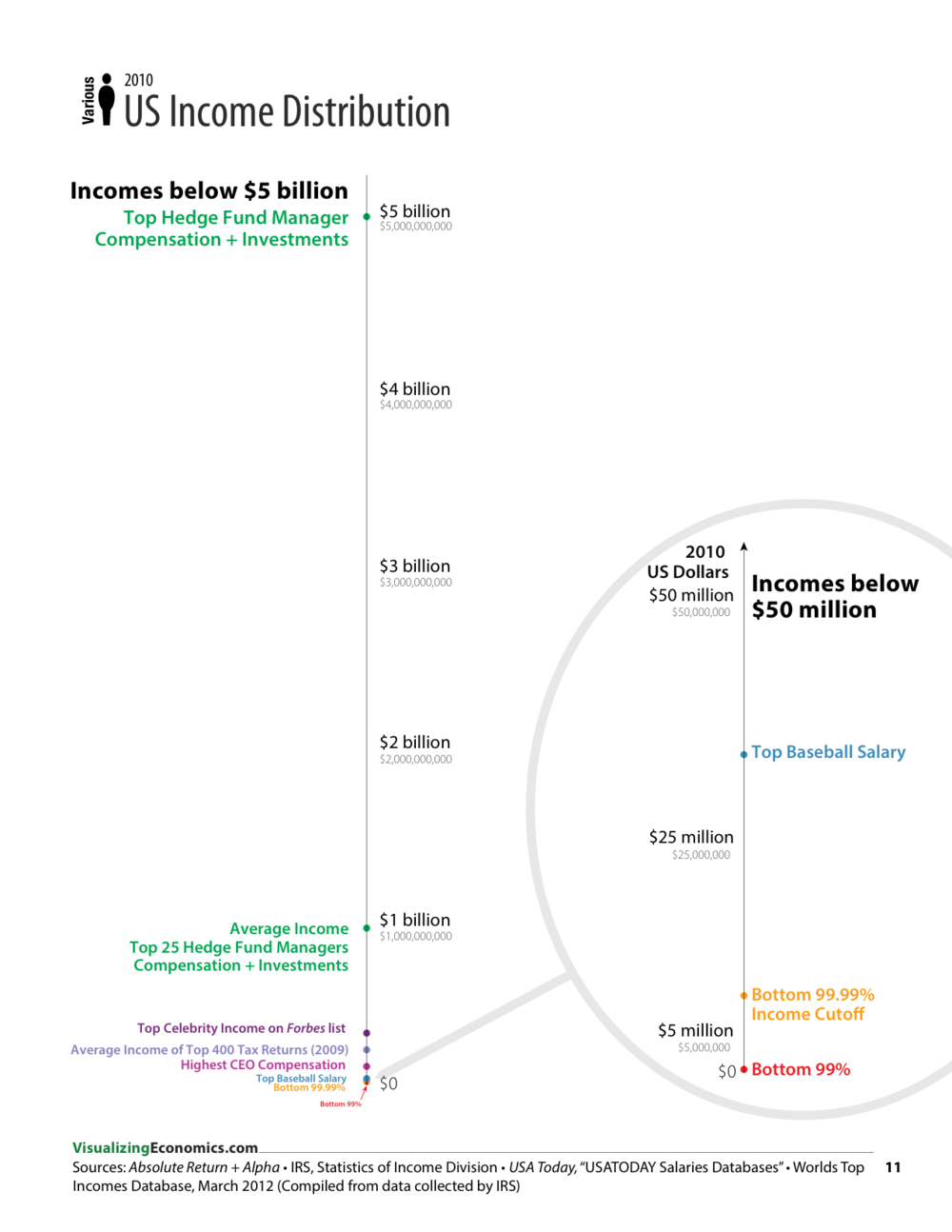
Ritholtz features a couple of great charts on income inequality. This one relates to the video in the previous post:
 $5 billion in a year? That is so fucking ridiculous that I just don't have words to describe it.

Family Budgets, In and Out of the Social Safety Net
Via The Atlantic Cities:


This month, the Bureau of Labor Statistics compared yearly spending between families that use public assistance programs, such as food stamps and Medicaid, and families that don't. And surprise, surprise, households that rely on the safety net lead some pretty frugal lifestyles. On average, they spend $30,582 in a year, compared to $66,525 for families not on public assistance. Meanwhile, they spend a third less on food, half as much on housing, and 60 percent less on entertainment.But that surfer on Fox News buys lobster, so we know folks in government programs have it easy! I think I'll pay my taxes and be happy I'm not struggling to rotate which bills to pay this month. Then again, because of how the tax laws are structured, I can stash away over $16,000 in a tax deferred 401K account while folks I know try to raise children on not much more than that in income. I've told conservatives I know that they can quit their jobs and take government programs if it is such a good deal, but they say they are too proud. Also, that might cut into their Keno playing funds.
These figures, drawn from the 2011 Consumer Expenditure Survey, don't capture all non-cash perks some low-income families get from the government, such as healthcare coverage through Medicaid. But they give you a sense of the kind of tight finances these families deal with.
Monday, December 9, 2013
On Two Americas, and Capitalism's Threat To Itself
I highly recommend this speech by David Simon. A sample:
And that notion that capital is the metric, that profit is the metric by which we're going to measure the health of our society is one of the fundamental mistakes of the last 30 years. I would date it in my country to about 1980 exactly, and it has triumphed.Please, go read the whole thing.
Capitalism stomped the hell out of Marxism by the end of the 20th century and was predominant in all respects, but the great irony of it is that the only thing that actually works is not ideological, it is impure, has elements of both arguments and never actually achieves any kind of partisan or philosophical perfection.
It's pragmatic, it includes the best aspects of socialistic thought and of free-market capitalism and it works because we don't let it work entirely. And that's a hard idea to think – that there isn't one single silver bullet that gets us out of the mess we've dug for ourselves. But man, we've dug a mess.
Friday, December 6, 2013

Sunday, December 1, 2013
Job Creators? Not Quite

"Rich people create the jobs."Lots of people don't believe this, which seems obvious to me. Income inequality cuts a large percentage of people out of being able to fully support the economy, while a smaller percentage of the population has way more money than they could ever use to benefit the economy. Why have we had so many bubbles? Mainly because all the excess wealth is being employed in speculating for greater gains. All those dollars are chasing a finite number of potential investments. If you are really concerned about a balanced budget, you would support taxing more of that wealth, or creating regulations to ensure that more of the national income went to labor. Most "budget hawks" are opposed to both.
Specifically, by starting and directing America's companies, entrepreneurs and rich investors create the jobs that sustain everyone else.
This statement is usually invoked to justify cutting taxes on entrepreneurs and investors. If only we reduce those taxes and regulations, the story goes, entrepreneurs and investors can be incented to build more companies and create more jobs.
This argument ignores the fact that taxes on entrepreneurs and investors are already historically low, even after this year's modest increases. And it ignores the assertions of many investors and entrepreneurs (like me) that they would work just as hard to build companies even if taxes were higher.
But, more importantly, this argument perpetuates a myth that some well-off Americans use to justify today's record inequality — the idea that rich people create the jobs.Entrepreneurs and investors like me actually don't create the jobs -- not sustainable ones, anyway.
Yes, we can create jobs temporarily, by starting companies and funding losses for a while. And, yes, we are a necessary part of the economy's job-creation engine. But to suggest that we alone are responsible for the jobs that sustain the other 300 million Americans is the height of self-importance and delusion.
So, if rich people do not create the jobs, what does?
A healthy economic ecosystem — one in which most participants (especially the middle class) have plenty of money to spend.
Over the last couple of years, a rich investor and entrepreneur named Nick Hanauer has annoyed all manner of other rich investors and entrepreneurs by explaining this in detail...
What creates a company's jobs, Hanauer explains, is a healthy economic ecosystem surrounding the company, which starts with the company's customers.
The company's customers buy the company's products. This, in turn, channels money to the company and allows the the company to hire employees to produce, sell, and service those products. If the company's customers and potential customers go broke, the demand for the company's products will collapse. And the company's jobs will disappear, regardless of what the entrepreneurs or investors do.
Tuesday, November 26, 2013
More Catholic Than I Think?
It looks like the Pope and I agree on a few things:
Pope Francis is once again shaking things up in the Catholic Church. On Tuesday, he issued his first “apostolic exhortation,” declaring a new enemy for the Catholic Church: modern capitalism. “Some people continue to defend trickle-down theories which assume that economic growth, encouraged by a free market, will inevitably succeed in bringing about greater justice and inclusiveness in the world,” he wrote. “This opinion, which has never been confirmed by the facts, expresses a crude and naive trust in the goodness of those wielding economic power and in the sacralized workings of the prevailing economic system.”This will burn up the conservatives. But shit, who can claim that "trickle down economics" works? We've got over thirty years of it not working, and we keep being told that it will work with one more tax cut. Bullshit. Taxes should go up on the very high end of the income range. You don't have to be the Vicar of Christ to figure that shit out, but I'm glad he's out there pointing out the shortcomings of our supposedly capitalist economy.
He couldn't be much clearer. The pope has taken a firm political stance against right-leaning, pro-free market economic policies, and his condemnation appears to be largely pointed at Europe and the United States. His explicit reference to “trickle-down” economic policies—the hallmark of Ronald Reagan, Margaret Thatcher, and their political successors—is just the beginning: Throughout 224 pages on the future of the Church, he condemns income inequality, “the culture of prosperity,” and “a financial system which rules rather than serves.”
Taken in the context of the last half-century of Roman Catholicism, this is a radical move. Fifty years ago, around the time of the Second Vatican Council, Church leaders quietly declared a very different economic enemy: communism. But Pope Francis’s communitarian, populist message shows just how far the Church has shifted in five decades—and how thoroughly capitalism has displaced communism as a monolithic political philosophy.
Thursday, November 21, 2013
Elite Overproduction?
From Bloomberg:


That's a pretty interesting take on history. I think income inequality is a bigger deal than most folks think. Hopefully, the issue can be defused before we have serious political instability.
Past waves of political instability, such as the civil wars of the late Roman Republic, the French Wars of Religion and the American Civil War, had many interlinking causes and circumstances unique to their age. But a common thread in the eras we studied was elite overproduction. The other two important elements were stagnating and declining living standards of the general population and increasing indebtedness of the state.
Elite overproduction generally leads to more intra-elite competition that gradually undermines the spirit of cooperation, which is followed by ideological polarization and fragmentation of the political class. This happens because the more contenders there are, the more of them end up on the losing side. A large class of disgruntled elite-wannabes, often well-educated and highly capable, has been denied access to elite positions....This U.S. historical cycle didn’t end with the cataclysm of the Civil War. Huge fortunes were made during the Gilded Age and economic inequality reached a peak, unrivaled even today. The number of lawyers tripled from 1870 to 1910. And the U.S. saw another wave of political violence, spiking in 1919–21.
This was the worst period of political instability in U.S. history, barring the Civil War. Class warfare took the form of violent labor strikes. At one point 10,000 miners armed with rifles were battling against thousands of company troops and sheriff deputies. There was a wave of terrorism by labor radicals and anarchists. Race issues intertwined with class, leading to the Red Summer of 1919, with 26 major riots and more than 1,000 casualties. It was much, much worse than the 1960s and early 1970s, a period many of us remember well because we lived through it (see chart).
Tuesday, November 19, 2013

Sunday, November 17, 2013
Fast Food Workers and Social Welfare Programs

The Wall Street Journal looks at the issue (h/t Ritholtz):
I find it interesting that the two industries with the highest percentage of employees who had family members on social welfare programs were both food production or provision industries. So does that have something to do with the government subsidizing cheap food? I don't see how, when profits for the companies have increased over time. I think this does have to do with the half-assed employer-based health care system we have, and the fact that the restaurant industry has long used part-time help that they stiffed on health insurance. I would be curious to know what would happen if we got an increased minimum wage combined with a tax on large businesses that don't provide health insurance based on their total number of part-time and full-time workers. I would expect they might cut part-time employees, but dramatically increase full-time workers. In the end, an employer-based system doesn't work if an increasing number of employers don't provide insurance. Since we are there, we need to work out a different system.One point that isn't disputed: $7 billion isn't much, in the context of the U.S. fast-food industry and of government benefits. It is about one-fifth or one-quarter as much as fast-food restaurants pay their front-line workers in wages and benefits. And it is less than 2% of the total benefits paid out by the four programs studied by the researchers.Why, then, focus on fast food? "$7 billion is $7 billion. You have to start somewhere," Dr. Allegretto said, adding that the proportion of fast-food workers who receive benefits from those programs—52%—is larger than in other major industry categories she and her colleagues studied.Dr. Allegretto said the figure is an underestimate, for several reasons. First, there is no ready-made data set of fast-food workers, so researchers used three different sources and several assumptions. "We always erred on the side of being conservative," she said. The researchers also omitted many other benefits programs.Some economists praised the research, which hasn't yet been published in a peer-reviewed journal. "They produced the best estimates available using sound methods and data," said Aaron J. Sojourner, a labor economist at the Carlson School of Management at the University of Minnesota.
Monday, November 11, 2013

Thursday, October 31, 2013
Bill Gross Not Talking His Book
At least for once:
Bill Gross is feeling guilty about being among the wealthiest people in America. That's why he thinks that he and other filthy rich members of the 1% should pay more in taxes.I've been critical of Gross at times, but in this case, he gets it. Today's inequality is staggering, and it can't last. There are two options, raise wages or raise taxes. I'd be happier than hell to see this be handled by the private sector, but I won't hold my breath.
"Having gotten rich at the expense of labor, the guilt sets in and I begin to feel sorry for the less well-off," writes Gross, co-founder of investment firm Pimco and manager of the biggest bond fund in the world, in the opening of his latest monthly investment letter.
Gross usually devotes his outlook pieces to discussions of the bond market. And they are often littered with pop culture references. He didn't disappoint this month.
He compared those who complain about paying a greater percentage of their wealth in taxes to the Disney (DIS, Fortune 500) character Scrooge McDuck.
"It's time to kick out and share some of your good fortune by paying higher taxes and reforming them to favor economic growth and labor, as opposed to corporate profits and individual gazillions," Gross wrote.
Gross is at the very top of the ultra-rich group he is talking about. Forbes estimates his net worth at $2.2 billion, which would put him in the top 0.01%.
Gross said he and other top 1% earners need to recognize that they have had the "privilege of riding the credit wave and a credit boom for the past three decades. Paraphrasing President Obama's "you didn't build that" comment from the 2012 campaign, Gross reminds the rich "you did not create that wave. You rode it."
Wednesday, October 30, 2013
How Do People Survive on the Minimum Wage?
With government assistance:
So how do millions of Americans do it? This statistic helps explain it:I still remember thinking how stupid it sounded when "Papa John" said it would cost an extra 14 cents a pizza to provide health insurance, that sounded like a pretty good deal. Would better pay for workers be a pretty good trade off for getting a little less change back on fast food and Walmart purchases? I'd say so.More than half of fast food workers have to rely on public assistance programs since their wages aren't enough to support them, a new report found.Assuming fast-food workers are good proxy for minimum-wage workers, this actually explains a lot. If it sounds impossible to get by on less than $1,000 a month, that's because it probably is, and most minimum-wage workers don't. They earn a wage that isn't sufficient to support them, and various government assistance programs make up the difference.
According to a University of California Berkeley Labor Center and University of Illinois study out Tuesday, 52% of families of fast food workers receive assistance from a public program like Medicaid, food stamps, the Earned Income Tax Credit and Temporary Assistance for Needy Families. That's compared to 25% of families in the workforce as a whole.
The report estimated that this public aid carries a $7 billion price tag for taxpayers each year
Public assistance isn't just for those out of work, down on their luck, or in a short-term bind. It's for those who are gainfully employed but earning such a low wage they can't sustain themselves. Which is to say: The reason fast-food and other low-wage employers can get away with paying so little is because taxpayers subsidize the slack. The report estimates McDonald's (NYSE: MCD ) subsidy alone is worth $1.2 billion a year, which equates to more than a fifth of its 2012 profits.
Tuesday, October 29, 2013
Robot Takeover Watch
From Bloomberg:

Wow, that is a lot of robots. That doesn't bode well for a healthy middle class.

Prosperity in Thailand is spreading from glitzy Bangkok to less-developed regions, thanks in part to a boom in auto-manufacturing in places such as Rayong province, where this state-of-the-art Ford plant is located.
Wow, that is a lot of robots. That doesn't bode well for a healthy middle class.
Thursday, October 24, 2013
Why We Need Higher Marginal Rates
The Guardian:
In the United States, the share of total pre-tax income accruing to the top 1% has more than doubled, from less than 10% in the 1970s to over 20% today (pdf). A similar pattern is true of other English-speaking countries. Contrary to the widely-held view, however, globalisation and new technologies are not to blame. Other OECD countries, such as those in continental Europe, or Japan have seen far less concentration of income among the mega rich.I was just trying to make this point on Tuesday night to a couple of Tea Party Libertarian types I went to high school with. They looked at me like I had 3 heads. To me, it makes pretty damn good sense, but it seems most folks around here just think it is the worst idea in the world. My point is that if something doesn't change, the so-called defenders of Capitalism will end up being its destroyers. With widening inequality, somethings gotta give. I'd much rather it be low tax rates on top incomes that go away than society as we know it.
At the same time, top income tax rates on upper income earners have declined significantly since the 1970s in many OECD countries – again, particularly in English-speaking ones. For example, top marginal income tax rates in the United States or the United Kingdom were above 70% in the 1970s, before the Reagan and Thatcher revolutions drastically cut them by 40 percentage points within a decade.
At a time when most OECD countries face large deficits and debt burdens, a crucial public policy question is whether governments should tax high earners more. The potential tax revenue at stake is now very large.
For example, doubling the average US individual income tax rate on the top 1% income earners from the current 22.5% level to 45% would increase tax revenue by 2.7% of GDP per year – as much as letting all of the Bush tax cuts expire (only a small fraction of them lapsed in January 2013). But of course, this simple calculation is static: such a large increase in taxes may well affect the economic behaviour of the rich and the income they report pre-tax, the broader economy and, ultimately, the tax revenue generated. In recent research, we analyse this issue both conceptually and empirically using international evidence on top incomes and top tax rates since the 1970s.
There is a strong correlation between the reductions in top tax rates and the increases in top 1% pre-tax income shares, for the period from 1975-79 to 2004-08, across 18 OECD countries for which top income share information is available. For example, the United States experienced a 35 percentage-point reduction in its top income tax rate and a very large ten percentage-point increase in its top 1% pre-tax income share. By contrast, France or Germany saw very little change in their top tax rates and their top 1% income shares during the same period.
Monday, October 21, 2013
A Couple Depressing Maps
This:

and:
 A little explanation:

and:

A majority of public school children in 17 states, one-third of the 50 states across the nation, were low income students – eligible for free or reduced lunches – in the school year that ended in 2011. Thirteen of the 17 states were in the South, and the remaining four were in the West. Since 2005, half or more of the South’s children in public schools have been from low income households.There is a little nuance to this information, as whites fled to private schools throughout the south after integration took place. But still, the numbers are very depressing. These ans more maps of economic hardship are here.
Low income is defined as below 130% of the poverty line and these kids qualify for a free lunch. Poverty also significantly impacts reading test scores, school opportunities and the ability to go to college. When one just looks at cities, the situation is much worse. Kids in public schools who are low income account for 59.8% on average of all students in K-12 public schools. Any urban area with a population greater than 100,000 is teeming with America's poor. Mississippi had the highest rate of low income students, 83%, In New Jersey cities 78% of the students are poor and Louisiana, Illinois and Oklahoma all low income rates of greater than 70% for their K-12 students.
Sunday, September 22, 2013
Winners And Losers of the Financial Crisis

The LA Times reports on who came out of the financial disaster of 2008 better off, and who got pummeled. Not surprisingly, the big winners were banks, giant corporations and the ultra-wealthy, while the big losers were ordinary people with money in bank accounts, low wage and factory workers, and foreclosed and underwater homeowners. A little bit of their analysis on the banks:
In the second quarter of this year U.S. banks earned a total of $42.2 billion — the biggest industry profit in history, and double the earnings of the same period in 2010.And for corporations:
It's no accident that the banks have prospered mightily since the crash, said Neil Barofsky, who was the watchdog over the U.S. bank bailout program launched in September 2008.
"We turned the entire resources of the nation toward one goal: setting up a situation where the banks could earn their way out of this," said Barofsky, now an attorney at Jenner & Block in New York. The plan was not, he lamented, "about holding institutions accountable" for the debacle.
After brokerage giant Lehman failed Sept. 15, 2008, credit seized up and the financial system became a place of titanic falling dominoes: Merrill Lynch & Co., Wachovia Corp., American International Group Inc., Washington Mutual Inc. Rotten home loans were at the core of it all.
The Bush administration scrambled for a plan to restore confidence in the system. The $700-billion Troubled Asset Relief Program, or TARP, was created to buy bad loans from banks. But the government quickly switched course and instead used the money to make investments in hundreds of banks, bolstering their capital cushions.
Yet in the longer run, TARP was less significant for many banks than the aid of the Federal Reserve under Chairman Ben S. Bernanke.
The government's broadest measure of corporate earnings reached an annualized rate of $2.1 trillion in the second quarter, an all-time high and more than double the rate at the end of 2008.Meanwhile, most Americans are no better off, or worse off than they were before the crisis. It would be nice if there was a political party who looked out for common folks against the banks, corporations and ultra-wealthy folks who use their wealth and power to secure more for themselves at the expense of everybody else. However, we don't seem to have one.
The dramatic rebound in earnings has occurred despite a slow-growing U.S. economy and continued weakness abroad, particularly in Europe.
Corporations' profit success stems in part from the layoffs and other deep cost-cutting many firms undertook in the 2008-09 recession — and their relative lack of domestic hiring since. And, like the banks, companies have reaped the benefits of the Fed's super-low interest rates by refinancing debt.
The surge in earnings has helped buttress stock prices, which are near record highs.
Thursday, September 19, 2013
Was The Taper Talk A Miscalculation?
There have been quite a few folks attacking Ben Bernanke for misleading the markets about whether the Fed would taper QE3 bond buying:
 Also:
Also:
But back to my question. What if the telegraphing of September tapering was to see what the post-taper world might look like? How many people got hurt by it? Mainly just traders and speculators. Now sure, some folks got hurt by the higher interest rates the last few months, like home buyers and municipalities issuing debt. But how many more would have been hurt if the Fed just plowed into ending QE3 for good? If the folks most hurt were the speculators, I'm not losing much sleep. But it does explain why so many folks on Wall Street felt so betrayed. I think that Bernanke and company realize much more than our Wall Street fat cats that most people out there are still suffering from the not-so-booming economy, and definitely unlike the folks on Wall Street, the rest of the country is still poorer than they were five years ago. So, in the end, I think the Fed was right in postponing the taper. I just wish they could come up with some ways to help out the common folks, and not just the Wall Street assholes.
Economists and market analysts on Thursday blasted Federal Reserve chief Ben Bernanke after the Fed stunned markets with its unexpected decision to not cut its stimulus.I've got a question, though. What if the Federal Reserve wanted to get a feeling for where interest rates would go if they did end their bond purchases, and they wanted to see what kind of effects the higher interest rates would have on the real economy? What better way to find out than to give the market the impression that the bond buying was coming to an end? What if May to September was an experiment to see what the post-taper world would look like, and whether it was just too soon to stop? I would say the Fed got a really good idea of how much the mortgage market would slow down, as Calculated Risk's chart shows:
Bernanke came under fire for having stoked nearly unanimous expectations that the Fed would announce the "taper" of its $85 billion a month bond-buying program after its policy meeting Wednesday.
The decision cost investors who bet on a stimulus cutback hugely, though benefiting many with long positions in global stocks.
Many blamed Bernanke and fellow members of the Federal Open Market Committee (FOMC) for having since May repeatedly suggested a September taper of the quantitative easing (QE) program.
University of Michigan economist Justin Wolfers called the surprise "the result of a needless miscommunication.
"This whole taper debate is one that should never have happened," he wrote.
After Bernanke first spoke of a stimulus cut in May and June, "taper-talk came to dominate the financial headlines, and a monetary meme was quickly born. The result... was that markets over-reacted," he said.
"Despite Bernanke's effort yesterday in the press conference to paint the FOMC decision as entirely consistent with earlier communication from the FOMC, it was not," said Chris Low at FTN Financial.
"The Fed may have done the right thing for the economy... but the Fed's communications credibility is shredded."

But the key is the refinance index is down 65% since early May, we will probably see the refinance index back to 2000 levels soon.The second graph shows the MBA mortgage purchase index.Not only that, but Bernanke and company were able to see that no matter what the economy is doing, Republicans in Congress are crazy enough to blow it up. They've come to realize that there is no chance of fiscal policy moving in the direction where it is a help to the economy and not a major hindrance.
The 4-week average of the purchase index was generally been trending up over the last year (but down over the last few months), and the 4-week average of the purchase index is up about 3% from a year ago.
But back to my question. What if the telegraphing of September tapering was to see what the post-taper world might look like? How many people got hurt by it? Mainly just traders and speculators. Now sure, some folks got hurt by the higher interest rates the last few months, like home buyers and municipalities issuing debt. But how many more would have been hurt if the Fed just plowed into ending QE3 for good? If the folks most hurt were the speculators, I'm not losing much sleep. But it does explain why so many folks on Wall Street felt so betrayed. I think that Bernanke and company realize much more than our Wall Street fat cats that most people out there are still suffering from the not-so-booming economy, and definitely unlike the folks on Wall Street, the rest of the country is still poorer than they were five years ago. So, in the end, I think the Fed was right in postponing the taper. I just wish they could come up with some ways to help out the common folks, and not just the Wall Street assholes.
Friday, September 13, 2013
Insourcing Trend Appears Oversold
Bloomberg:
Randy Webb sees scant evidence of a U.S. manufacturing rebound in the Ohio plant where he’s fixed aircraft electronics for 25 years. Honeywell International Inc. (HON) is closing the shop in 2014 as it expands such work overseas.The story earlier in the year about GE's Appliance Park made me a little hopeful, but alas, it may have been a bit oversold. The other thing hurting manufacturing job creation is investment in labor saving technology. It will be interesting to see if the supposed shale gas manufacturing bonanza occurs. I'd bet it is decently oversold.
Webb is among 80 employees poised to lose their jobs in Strongsville, Ohio, outside Cleveland, near where General Electric Co. (GE) will shut a lighting factory in favor of production in Hungary. Delphi Automotive Plc (DLPH) is sending parts assembly to Mexico from Flint, Michigan, and Eaton Corp. (ETN) will make extra-large hydraulic cylinders in the Netherlands, not Alabama...
The U.S. industrial comeback, an idea embraced by President Barack Obama and some economists as 12 years of factory-job losses gave way to three annual gains, is now sputtering. Even with nonfarm payrolls up 1.1 percent in 2013 to 136.1 million, manufacturing has stagnated at less than 12 million. Factories added more than 500,000 positions after falling in February 2010 to the lowest since 1941.
That left the factory workforce through August about 13 percent smaller than the 13.7 million when the U.S. fell into recession in December 2007. In 2000, the tally was 17 million... One discouraging sign that manufacturing employment is recovering: the 13 percent gap between factory payrolls now and before the recession occurred amid a rebound in output, said Tim Quinlan, a Wells Fargo & Co. economist in Charlotte, North Carolina. Industrial production trails a 2007 pre-recession high by only 1.9 percentage points.
Monday, September 2, 2013
Tax Reform?
Simplifying the tax code won't be easy. This chart helps explain why:


About half of all tax expenditures go to the top quintile (top 20 percent of income earners). The bottom 80 percent of earners divide the other half. And within that richest quintile, the top one percent receive 15 percent of all tax expenditures (this distribution of tax breaks roughly parallels the distribution of income).My big non-farm tax breaks are the state and local tax exemptions, the charitable deduction and the capital gains/dividend preference. The only one of those Republicans will want to go after is the state and local tax exemption, since they hate state and local taxes. I definitely think the dividend preference ought to go entirely, while capital gains taxes ought to go back to the Reagan era 28% level. Why should somebody working for a living pay more taxes on their income than somebody who's just sitting on stock investments? The charitable deduction probably ought to be overhauled, but nobody will ever come to agreement on that.
Tuesday, August 27, 2013


Subscribe to:
Posts (Atom)