Showing posts with label The New Gilded Age. Show all posts
Showing posts with label The New Gilded Age. Show all posts
Tuesday, December 17, 2013
More Crazy Numbers
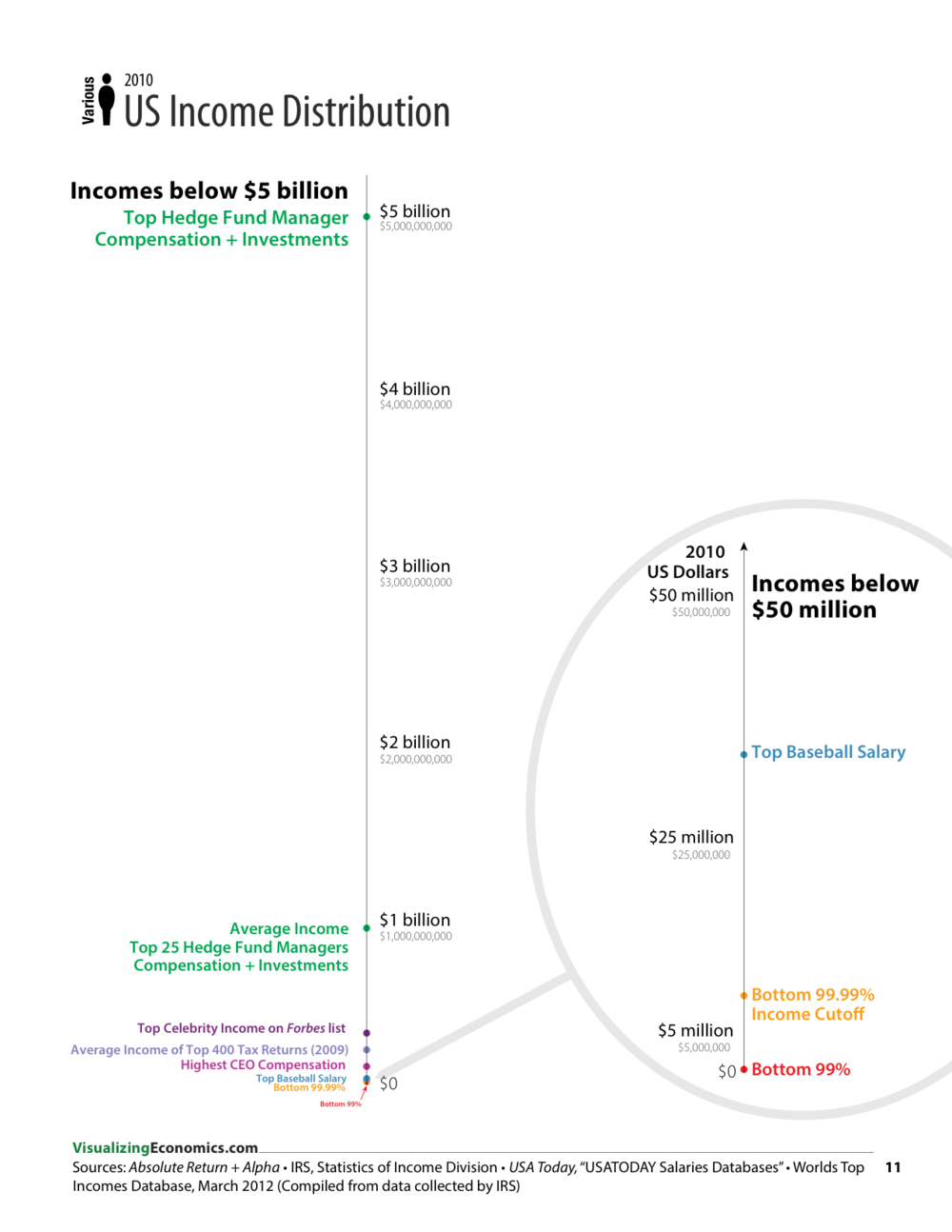
Ritholtz features a couple of great charts on income inequality. This one relates to the video in the previous post:
 $5 billion in a year? That is so fucking ridiculous that I just don't have words to describe it.

Monday, December 9, 2013
On Two Americas, and Capitalism's Threat To Itself
I highly recommend this speech by David Simon. A sample:
And that notion that capital is the metric, that profit is the metric by which we're going to measure the health of our society is one of the fundamental mistakes of the last 30 years. I would date it in my country to about 1980 exactly, and it has triumphed.Please, go read the whole thing.
Capitalism stomped the hell out of Marxism by the end of the 20th century and was predominant in all respects, but the great irony of it is that the only thing that actually works is not ideological, it is impure, has elements of both arguments and never actually achieves any kind of partisan or philosophical perfection.
It's pragmatic, it includes the best aspects of socialistic thought and of free-market capitalism and it works because we don't let it work entirely. And that's a hard idea to think – that there isn't one single silver bullet that gets us out of the mess we've dug for ourselves. But man, we've dug a mess.
Thursday, November 21, 2013
Elite Overproduction?
From Bloomberg:


That's a pretty interesting take on history. I think income inequality is a bigger deal than most folks think. Hopefully, the issue can be defused before we have serious political instability.
Past waves of political instability, such as the civil wars of the late Roman Republic, the French Wars of Religion and the American Civil War, had many interlinking causes and circumstances unique to their age. But a common thread in the eras we studied was elite overproduction. The other two important elements were stagnating and declining living standards of the general population and increasing indebtedness of the state.
Elite overproduction generally leads to more intra-elite competition that gradually undermines the spirit of cooperation, which is followed by ideological polarization and fragmentation of the political class. This happens because the more contenders there are, the more of them end up on the losing side. A large class of disgruntled elite-wannabes, often well-educated and highly capable, has been denied access to elite positions....This U.S. historical cycle didn’t end with the cataclysm of the Civil War. Huge fortunes were made during the Gilded Age and economic inequality reached a peak, unrivaled even today. The number of lawyers tripled from 1870 to 1910. And the U.S. saw another wave of political violence, spiking in 1919–21.
This was the worst period of political instability in U.S. history, barring the Civil War. Class warfare took the form of violent labor strikes. At one point 10,000 miners armed with rifles were battling against thousands of company troops and sheriff deputies. There was a wave of terrorism by labor radicals and anarchists. Race issues intertwined with class, leading to the Red Summer of 1919, with 26 major riots and more than 1,000 casualties. It was much, much worse than the 1960s and early 1970s, a period many of us remember well because we lived through it (see chart).
Tuesday, November 19, 2013

Thursday, October 3, 2013
Dow Original 12: American Tobacco
Yeah, this is how Duke University got founded:
The American Tobacco Company was a tobacco company founded in 1890 by J. B. Duke through a merger between a number of U.S. tobacco manufacturers including Allen and Ginter and Goodwin & Company. The company was one of the original 12 members of the Dow Jones Industrial Average in 1896.How did the Tobacco Trust break up? Like this:
The American Tobacco Company dominated the industry by acquiring the Lucky Strike Company and over 200 other rival firms. Antitrust action begun in 1907 broke the company into several major companies in 1911.
The American Tobacco Company restructured itself in 1969, forming a holding company called American Brands, Inc. which operated American Tobacco as a subsidiary. American Brands acquired a variety of non-tobacco businesses during the 1970s and 1980s, and sold its tobacco operations to Brown & Williamson in 1994. American Brands subsequently renamed itself Fortune Brands.
James Buchanan Duke’s entrance into the cigarette industry came about in 1879 when he elected to enter a new business rather than face competition in the smoking tobacco business against the Bull Durham brand, also from Durham, North Carolina.
In 1881, two years after W. Duke Sons & Company entered into the cigarette business, James Bonsack invented a cigarette-rolling machine. It produced over 200 cigarettes per minute, the equivalent of what a skilled hand roller could produce in one hour, and reduced the cost of rolling cigarettes by fifty percent. It cut each cigarette with precision, creating uniformity among the cigarettes it rolled. There was public stigma attached to this machine-rolled uniformity, and Allen & Ginter rejected the machine almost immediately.
Duke set a deal with the Bonsack Machine Company in 1884. Duke agreed to produce all cigarettes with his two rented Bonsack machines and in return Bonsack reduced Duke’s royalties from $0.30 per thousand to $0.20 per thousand. Duke also hired one of Bonsack’s mechanics, resulting in fewer breakdowns of his machines than his competitors’. This secret contract resulted in a competitive advantage over Duke’s competitors; he was able to lower his prices further than others could.
In the 1880s, while Duke was beginning to machine-roll all his cigarettes, he saw that growth rates in the cigarette industry were declining. His solution was to combine companies and found “one of the first great holding companies in American history.” Duke spent $800,000 on advertising in 1889 and lowered his prices, accepting net profits of less than $400,000, forcing his major competitors to lower their prices and, in 1890, join his consortium by the name of the American Tobacco Company. The five constituent companies of American Tobacco: W. Duke & Sons, Allen & Ginter, W.S. Kimball & Company, Kinney Tobacco and Goodwin & Company – produced 90% of the cigarettes made in 1890, the first year the American Tobacco Company was listed on the NYSE. Within two decades of its founding, the American Tobacco company absorbed about 250 companies and produced 80% of the cigarettes, plug tobacco, smoking tobacco, and snuff produced in the United States. With Duke’s innovation, American Tobacco grew its equity from $25,000,000 to $316,000,000.
Four firms were created from the American Tobacco Company’s assets: American Tobacco Company, R. J. Reynolds, Liggett & Myers, and Lorillard. The monopoly became an oligopoly. The main result of the dissolution of American Tobacco Trust and the creation of these companies was an increase in advertising and promotion in the industry as a form of competition.The original Dow was pretty much all trusts.
Sunday, September 22, 2013
Winners And Losers of the Financial Crisis

The LA Times reports on who came out of the financial disaster of 2008 better off, and who got pummeled. Not surprisingly, the big winners were banks, giant corporations and the ultra-wealthy, while the big losers were ordinary people with money in bank accounts, low wage and factory workers, and foreclosed and underwater homeowners. A little bit of their analysis on the banks:
In the second quarter of this year U.S. banks earned a total of $42.2 billion — the biggest industry profit in history, and double the earnings of the same period in 2010.And for corporations:
It's no accident that the banks have prospered mightily since the crash, said Neil Barofsky, who was the watchdog over the U.S. bank bailout program launched in September 2008.
"We turned the entire resources of the nation toward one goal: setting up a situation where the banks could earn their way out of this," said Barofsky, now an attorney at Jenner & Block in New York. The plan was not, he lamented, "about holding institutions accountable" for the debacle.
After brokerage giant Lehman failed Sept. 15, 2008, credit seized up and the financial system became a place of titanic falling dominoes: Merrill Lynch & Co., Wachovia Corp., American International Group Inc., Washington Mutual Inc. Rotten home loans were at the core of it all.
The Bush administration scrambled for a plan to restore confidence in the system. The $700-billion Troubled Asset Relief Program, or TARP, was created to buy bad loans from banks. But the government quickly switched course and instead used the money to make investments in hundreds of banks, bolstering their capital cushions.
Yet in the longer run, TARP was less significant for many banks than the aid of the Federal Reserve under Chairman Ben S. Bernanke.
The government's broadest measure of corporate earnings reached an annualized rate of $2.1 trillion in the second quarter, an all-time high and more than double the rate at the end of 2008.Meanwhile, most Americans are no better off, or worse off than they were before the crisis. It would be nice if there was a political party who looked out for common folks against the banks, corporations and ultra-wealthy folks who use their wealth and power to secure more for themselves at the expense of everybody else. However, we don't seem to have one.
The dramatic rebound in earnings has occurred despite a slow-growing U.S. economy and continued weakness abroad, particularly in Europe.
Corporations' profit success stems in part from the layoffs and other deep cost-cutting many firms undertook in the 2008-09 recession — and their relative lack of domestic hiring since. And, like the banks, companies have reaped the benefits of the Fed's super-low interest rates by refinancing debt.
The surge in earnings has helped buttress stock prices, which are near record highs.
Thursday, September 19, 2013
Was The Taper Talk A Miscalculation?
There have been quite a few folks attacking Ben Bernanke for misleading the markets about whether the Fed would taper QE3 bond buying:
 Also:
Also:
But back to my question. What if the telegraphing of September tapering was to see what the post-taper world might look like? How many people got hurt by it? Mainly just traders and speculators. Now sure, some folks got hurt by the higher interest rates the last few months, like home buyers and municipalities issuing debt. But how many more would have been hurt if the Fed just plowed into ending QE3 for good? If the folks most hurt were the speculators, I'm not losing much sleep. But it does explain why so many folks on Wall Street felt so betrayed. I think that Bernanke and company realize much more than our Wall Street fat cats that most people out there are still suffering from the not-so-booming economy, and definitely unlike the folks on Wall Street, the rest of the country is still poorer than they were five years ago. So, in the end, I think the Fed was right in postponing the taper. I just wish they could come up with some ways to help out the common folks, and not just the Wall Street assholes.
Economists and market analysts on Thursday blasted Federal Reserve chief Ben Bernanke after the Fed stunned markets with its unexpected decision to not cut its stimulus.I've got a question, though. What if the Federal Reserve wanted to get a feeling for where interest rates would go if they did end their bond purchases, and they wanted to see what kind of effects the higher interest rates would have on the real economy? What better way to find out than to give the market the impression that the bond buying was coming to an end? What if May to September was an experiment to see what the post-taper world would look like, and whether it was just too soon to stop? I would say the Fed got a really good idea of how much the mortgage market would slow down, as Calculated Risk's chart shows:
Bernanke came under fire for having stoked nearly unanimous expectations that the Fed would announce the "taper" of its $85 billion a month bond-buying program after its policy meeting Wednesday.
The decision cost investors who bet on a stimulus cutback hugely, though benefiting many with long positions in global stocks.
Many blamed Bernanke and fellow members of the Federal Open Market Committee (FOMC) for having since May repeatedly suggested a September taper of the quantitative easing (QE) program.
University of Michigan economist Justin Wolfers called the surprise "the result of a needless miscommunication.
"This whole taper debate is one that should never have happened," he wrote.
After Bernanke first spoke of a stimulus cut in May and June, "taper-talk came to dominate the financial headlines, and a monetary meme was quickly born. The result... was that markets over-reacted," he said.
"Despite Bernanke's effort yesterday in the press conference to paint the FOMC decision as entirely consistent with earlier communication from the FOMC, it was not," said Chris Low at FTN Financial.
"The Fed may have done the right thing for the economy... but the Fed's communications credibility is shredded."

But the key is the refinance index is down 65% since early May, we will probably see the refinance index back to 2000 levels soon.The second graph shows the MBA mortgage purchase index.Not only that, but Bernanke and company were able to see that no matter what the economy is doing, Republicans in Congress are crazy enough to blow it up. They've come to realize that there is no chance of fiscal policy moving in the direction where it is a help to the economy and not a major hindrance.
The 4-week average of the purchase index was generally been trending up over the last year (but down over the last few months), and the 4-week average of the purchase index is up about 3% from a year ago.
But back to my question. What if the telegraphing of September tapering was to see what the post-taper world might look like? How many people got hurt by it? Mainly just traders and speculators. Now sure, some folks got hurt by the higher interest rates the last few months, like home buyers and municipalities issuing debt. But how many more would have been hurt if the Fed just plowed into ending QE3 for good? If the folks most hurt were the speculators, I'm not losing much sleep. But it does explain why so many folks on Wall Street felt so betrayed. I think that Bernanke and company realize much more than our Wall Street fat cats that most people out there are still suffering from the not-so-booming economy, and definitely unlike the folks on Wall Street, the rest of the country is still poorer than they were five years ago. So, in the end, I think the Fed was right in postponing the taper. I just wish they could come up with some ways to help out the common folks, and not just the Wall Street assholes.
Tuesday, September 10, 2013
The DJIA Through History

When the Dow Jones Industrial Average launched in 1896, it smelled like a turn-of-the-century factory farm -- nothing but oil, iron, cows, and cotton. You know. America. (Or as some folks prefer, 'Merica!)I really find the list fascinating. And I think it deserves a little more attention than Thompson gave it. The reason is that to kind of paraphrase Calvin Coolidge, "The history of the United States is the history of United States business (and probably religion)." Almost all of the companies above are monopoly trusts (the Sugar trust, the Tobacco trust, the Whiskey trust (Distilling & Cattle Feeding), the Leather trust, the Rubber trust, etc.). This was a very distinct period of time in the nation's history, and led to the modern state we now have. There is a lot of interesting history in there.
Today, practically all of these companies -- Tennessee Coal & Iron, American Cotton Oil, Distilling & Cattle Feeding -- have been gobbled up by conglomerates that you have and haven't heard of. Only GE remains. Only the U.S. Leather trust is essentially defunct.
But I like that. We had an industrial-dominated economy, and now we don't. New time, new index. DJIA II for the auto and aerospace economy. DJIA III for the computer/financial economy. And so on.
For instance, Tennessee Coal & Iron:
The Tennessee Coal, Iron and Railroad Company (1852–1952), also known as TCI and the Tennessee Company, was a major American steel manufacturer with interests in coal and iron ore mining and railroad operations. Originally based entirely within Tennessee, it relocated most of its business to Alabama in the late nineteenth century. With a sizable real estate portfolio, the company owned several Birmingham satellite towns, including Ensley, Fairfield, Docena, Edgewater and Bayview.So one of the steel mills from a company that disappeared from the Dow Jones Industrial Average in 1907 is still in operation, even though it employs 43,000 fewer people than at its peak. There is a lot of interesting shit in there. Company towns, forced convict labor, largest corporation in the country at the time, etc. In the next week or two, I'll try to pull up a few more interesting tidbits I found when I got bored at work today.
At one time the second largest steel producer in the USA, TCI was listed on the first Dow Jones Industrial Average in 1896. However, in 1907, the company was merged with its principal rival, the United States Steel Corporation. The Tennessee Coal, Iron and Railroad Company was subsequently operated as a subsidiary of U. S. Steel for 45 years until it became a division of its parent company in 1952.....
The Tennessee Coal, Iron and Railroad Company was one of the largest users of convict leasing for coal mining labor in Alabama following Reconstruction. The number of convicts employed increased after U.S. Steel acquired TCI in 1907, as did the brutality of the conditions in which they labored. In 1908, the first full year of U. S. Steel's ownership of TCI, almost 60 convict workers died from workplace-related accidents.
In the 1910s, TCI undertook a comprehensive program to stabilize its labor force by developing rigorously-planned "model villages", thereby improving worker health, welfare and loyalty. This paternalistic approach carried with it obvious benefits for workers and their families, but also drew criticism for limiting the free movement and organization of labor....The last relic of the Tennessee Coal, Iron and Railroad Company, the Fairfield Plant, continues to be operated by U. S. Steel as one of its five integrated steel mills in the USA. It is the largest steel-making plant in Alabama, employing 2000 workers as of September 2006, down from a peak of 45,000 during World War II. With a single blast furnace and three basic oxygen process furnaces, amongst other various mills and production facilities, the plant produces 2.4 million tons of raw steel per annum and 640,000 tons of seamless tubular and sheet products, mainly for purchase by the booming oil industry in the region.
Update: A full listing of changes to the Dow.
Tuesday, September 3, 2013
News of the Obvious Headline of the Day
Thank you, Bloomberg (h/t nc links):
Investors Are Doing Better Than Workers
For one thing, growth is still too anemic to return the U.S. economy to anything resembling full employment for several more years, even under the most optimistic assumptions. At the same time, new evidence from the U.S. Bureau of Economic Analysis, which released its monthly personal income and spending report today, indicates that most of the modest growth has gone to the small share of the population that owns the vast majority of the country’s assets.And you know what is even more amazing than that? All of those dividends and capital gains are taxed at 15%, and none of that money is subject to FICA taxes (except for the big earners who get hit by the ObamaCare tax). So not only are the people who have so much already getting most of our economic gains, but they pay less in tax on those gains than do people who actually work for a living.
Since the beginning of 2013, total personal income has increased by about $323.3 billion, while total employee compensation has increased by just $112.5 billion. People who get their income from renting out real estate, from dividends on stocks and from interest payments on bonds got an additional $186.7 billion. (The rest of the growth came from Social Security, Medicare, Medicaid, and veterans’ benefits.) Put another way, workers only got about a third of the economic growth generated so far this year. That’s significantly less than their average share of income growth since the beginning of 2010, which was closer to about half.
This might not be so bad if the higher returns on assets encouraged new business investment, which in turn would create more jobs and lead to a broader recovery. So far, this hasn’t happened.
Monday, September 2, 2013
Tax Reform?
Simplifying the tax code won't be easy. This chart helps explain why:


About half of all tax expenditures go to the top quintile (top 20 percent of income earners). The bottom 80 percent of earners divide the other half. And within that richest quintile, the top one percent receive 15 percent of all tax expenditures (this distribution of tax breaks roughly parallels the distribution of income).My big non-farm tax breaks are the state and local tax exemptions, the charitable deduction and the capital gains/dividend preference. The only one of those Republicans will want to go after is the state and local tax exemption, since they hate state and local taxes. I definitely think the dividend preference ought to go entirely, while capital gains taxes ought to go back to the Reagan era 28% level. Why should somebody working for a living pay more taxes on their income than somebody who's just sitting on stock investments? The charitable deduction probably ought to be overhauled, but nobody will ever come to agreement on that.
Thursday, August 29, 2013
The Worst Idea In History
Ok, that might be a bit of an exaggeration, but the main purpose of a business being to create shareholder value has to be one of the most pernicious ideas in the past forty years:
It used to be a given that the interests of corporations and communities such as Endicott were closely aligned. But no more. Across the United States, as companies continue posting record profits, workers face high unemployment and stagnant wages.Read the whole thing. This idea and the anti-tax movement are behind 90% of today's economic inequality. And the thing is, it is just an absolutely terrible idea. Companies try to claim that they value their employees, but if the buy into the creating value for shareholders bunk as job number one, they really don't give a shit about their employees. And to put a finer point on the issue, we have this story about fracking companies screwing landowners out of royalties:
Driving this change is a deep-seated belief that took hold in corporate America a few decades ago and has come to define today’s economy — that a company’s primary purpose is to maximize shareholder value.
The belief that shareholders come first is not codified by statute. Rather, it was introduced by a handful of free-market academics in the 1970s and then picked up by business leaders and the media until it became an oft-repeated mantra in the corporate world.
Together with new competition overseas, the pressure to respond to the short-term demands of Wall Street has paved the way for an economy in which companies are increasingly disconnected from the state of the nation, laying off workers in huge waves, keeping average wages low and threatening to move operations abroad in the face of regulations and taxes.
This all presents a quandary for policymakers trying to combat joblessness and raise the fortunes of lower- and middle-class Americans. Proposals by President Obama and lawmakers on Capitol Hill to change corporate tax policy, for instance, are aimed at the margins of company behavior when compared with the overwhelming drive to maximize shareholder wealth.
“The shift in what employers think of as their role not just in the community but [relative] to their workforce is quite radical, and I think it has led to the last two jobless recoveries,” said Ron Hira, an associate professor of public policy at the Rochester Institute of Technology.
But manipulation of costs and other data by oil companies is keeping billions of dollars in royalties out of the hands of private and government landholders, an investigation by ProPublica has found. An analysis of lease agreements, government documents and thousands of pages of court records shows that such underpayments are widespread. Thousands of landowners like Feusner are receiving far less than they expected based on the sales value of gas or oil produced on their property. In some cases, they are being paid virtually nothing at all. In many cases, lawyers and auditors who specialize in production accounting tell ProPublica energy companies are using complex accounting and business arrangements to skim profits off the sale of resources and increase the expenses charged to landowners. Deducting expenses is itself controversial and debated as unfair among landowners, but it is allowable under many leases, some of which were signed without landowners fully understanding their implications. But some companies deduct expenses for transporting and processing natural gas, even when leases contain clauses explicitly prohibiting such deductions. In other cases, according to court files and documents obtained by ProPublica, they withhold money without explanation for other, unauthorized expenses, and without telling landowners that the money is being withheld. Significant amounts of fuel are never sold at all – companies use it themselves to power equipment that processes gas, sometimes at facilities far away from the land on which it was drilled. In Oklahoma, Chesapeake deducted marketing fees from payments to a landowner – a joint owner in the well – even though the fees went to its own subsidiary, a pipeline company called Chesapeake Energy Marketing. The landowner alleged the fees had been disguised in the form of lower sales prices. A court ruled that the company was entitled to charge the fees.There are several other crooked schemes employed involving shell companies and such. So how could anybody ever justify such blatant lying and theft? Yep:
“The duty of the corporation is to make money for shareholders,” [Owen] Anderson [ the Eugene Kuntz Chair in Oil, Gas & Natural Resources at the University of Oklahoma College of Law] said. “Every penny that a corporation can save on royalties is a penny of profit for shareholders, so why shouldn’t they try to save every penny that they can on payments to royalty owners?”Really? Companies are supposed to lie, cheat and steal to make money for shareholders? Fuck those bastards. And the kicker is that Chesapeake was paying much more in royalties before they overproduced gas, THEN they came up with ever more creative ways to fuck people over. If there is a Hell, there is no way these guys don't end up there.
Friday, August 23, 2013
ESPN's Greatest Threat? Income Inequality?

Derek Thompson:
When John Skipper, the president of ESPN, wants to worry about the future of the most valuable media company in the world -- not just think anxiously, but actively worry -- he doesn't focus on Google trying to buy exclusive rights to the NFL. He doesn't think about Apple going head-to-head with the cable companies. He doesn't think about CBS, or NBC, or FS1. If there's any acronym that truly scares him, it's CBO.Why is that such a problem for them?:
Yep. John Skipper thinks about income distribution tables.
The statistic that frightens him the most, he told a group of reporters in Bristol yesterday (which he also told me in a previous interview), is that the bottom 20 percent of American households still makes less than $15,000. And the poorest households are seeing the slowest wage growth in the country.
That's a problem, because ESPN and other networks are selling a mass product, the cable bundle, whose price has tripled in the last decade and a half. And the number-one driver of rising cable costs today are the sports rights that make ESPN so valuable. The cost of exclusive rights to show sports are growing about 7% annually through the rest of the decade, 4X faster than private sector compensation growth (graph below via RBC/click to expand)
But Skipper is persuaded that if more Americans were simply making a little more money, there would be no fraught discussion about cord-cutters and cable-nevers. "The real issue is economics," he said. "Most of the cord-cutting has been financial." Not only does the bottom quintile make less than 15,000 a year, as Skipper often points out, but also about a third of households make less than $30,000 in after-tax income, according to the Tax Policy Center's distributional analysis.It is good that some folks in big business are starting to notice this problem. In the end, the one industry that makes a ton of money based on so many people struggling to get by, and the one with the most politicians bought, is the finance industry. They love to extract fees from the people who can least afford it, and those are also ones who have to borrow money. I hope that enough businessmen who need consumers are able to realize that workers need to get a larger share of the profits of their labor.
"ESPN is a mass product," he said. Wage stagnation threatens to make it a luxury product.
Monday, August 19, 2013
Wednesday, August 14, 2013
Selling the Same Thing For A Long Time
I missed this previously:
On another bit of economic argument, Robert Reich makes some great points:
This follows on from his NYT weekly column last week, which quoted extensively from Michal Kalecki. As Krugman wrote then:Yeah, that falls in with the uncertainty canard. It is amazing how "uncertain" big business assholes get when a Democrat is elected. These are the same geniuses who thought things were going great in August of 2008. Back in 1932, Hoover claimed that the economy was tanking because the market feared Roosevelt getting elected. Likewise, people made the same claim in September of 2008. I guess that is appropriate, as Republicans think the policies of the twenties, or even the 1890s are where we should be today.
First, however, I want to recommend a very old essay that explains a great deal about the times we live in.Essentially Krugman’s (and indeed Kalecki’s) point is this – we have the macroeconomic tools to restart a robust recovery and get unemployment down but these tools are not being used for political reasons.
The Polish economist Michal Kalecki published “Political Aspects of Full Employment” 70 years ago. Keynesian ideas were riding high; a “solid majority” of economists believed that full employment could be secured by government spending. Yet Kalecki predicted that such spending would, nonetheless, face fierce opposition from business and the wealthy, even in times of depression. Why?
The answer, he suggested, was the role of “confidence” as a tool of intimidation. If the government can’t boost employment directly, it must promote private spending instead — and anything that might hurt the privileged, such as higher tax rates or financial regulation, can be denounced as job-killing because it undermines confidence, and hence investment. But if the government can create jobs, confidence becomes less important — and vested interests lose their veto power.
Kalecki argued that “captains of industry” understand this point, and that they oppose job-creating policies precisely because such policies would undermine their political influence. “Hence budget deficits necessary to carry out government intervention must be regarded as perilous.”
When I first read this essay, I thought it was over the top. Kalecki was, after all, a declared Marxist (although I don’t see much of Marx in his writings). But, if you haven’t been radicalized by recent events, you haven’t been paying attention; and policy discourse since 2008 has run exactly along the lines Kalecki predicted.
On another bit of economic argument, Robert Reich makes some great points:
We’ve also lost most living memory of an era in which we were all in it together — the Great Depression and World War II — when we succeeded or failed together. In those years we were palpably dependent on one another, and understood how much we owed each other as members of the same society.That, at its heart, is the explanation of what is wrong with our economy.
But I think the deeper explanation for what has happened has economic roots. From the end of World War II through the late 1970s, the economy doubled in size — as did almost everyone’s income. Almost all Americans grew together. In fact, those in the bottom fifth of the income ladder saw their incomes more than double. Americans experienced upward mobility on a grand scale.
Yet for the last three and a half decades, the middle class has been losing ground. The median wage of male workers is now lower than it was in 1980, adjusted for inflation.
In addition, all the mechanisms we’ve used over the last three decades to minimize the effects of this descent — young mothers streaming into paid work in the late 1970s and 1980s, everyone working longer hours in the 1990s, and then borrowing against the rising values of our homes — are now exhausted. And wages are still dropping — the median is now 4 percent below what it was at the start of the so-called recovery.
Meanwhile, income, wealth, and power have become more concentrated at the top than they’ve been in ninety years.
Saturday, August 10, 2013
Returns To Labor
Henry Blodgett makes the case that it isn't a requirement of capitalism to pay your employees as little as possible:
One obvious solution to this problem is for big companies to pay their people more — to share more of the vast wealth that they create with the people who create it.It would seem to me that this is common sense, but reading the comments sections of any blog post that suggests that current compensation schemes might not represent true value added brings down tons of comments about working harder and getting educated and earning what you get. As a person who works in an office at a factory, I can say that the guys on the floor in the summer heat, working 10 or 11 hour days putting together industrial fans, are contributing pretty significantly to the product going out the door to customers. They certainly work harder, physically, than any person in the office, under much worse conditions, but I'm pretty sure the folks in the air conditioning get paid more. However, it isn't even the office workers who get the most rewards from the business for the least work when things are going well. Unfortunately, our business hasn't been very profitable lately, but when it is, I can expect that much more of that profit will go to the owners who inherited the business from their parents or grandparents than will go to the guys sweating their asses off and actually earning that money for the business. Luckily for me, I happen to be more closely related to the owners than to the workers, but the injustice of the setup isn't lost on me. It just stuns me that so many people in the bottom part of the income pyramid buy into the tripe put out by the folks at the top to justify their position there. Someday, probably sooner rather than later, that will change.
The companies have record profit margins, so they can certainly afford to do this.
But, unfortunately, over the past three decades, what began as a healthy and necessary effort to make our companies more efficient has evolved into a warped consensus that the only value that companies create is financial (cash) and that the only thing managers and owners should ever worry about is making more of it.
This view is an insult to anyone who has ever dreamed of having a job that is about more than money. And it is a short-sighted and destructive view of capitalism, an economic system that sustains not just this country but most countries in the world.
This view has become deeply entrenched, though.
These days, if you suggest that great companies should serve several constituencies (customers, employees, and shareholders) and that American companies should share more of their wealth with the people who generate it (employees), you get called a "socialist." You get called a "liberal." You get told that you "don't understand economics." You get accused of promoting "wealth confiscation." You get told that, in America, people get paid what they deserve to get paid: Anyone who wants more money should go out and "start their own company" or "demand a raise" or "get a better job."
In other words, you get told that anyone who suggests that great companies should share the value they create with all three constituencies instead of just lining the pockets of shareholders is an idiot.
After all, these folks say, one law of capitalism is that employers pay their employees as little as possible. Employees are just "costs." You should try to minimize those "costs" whenever and wherever you can.
This view, unfortunately, is not just selfish and demeaning. It's also economically stupid. Those "costs" you are minimizing (employees) are also current and prospective customers for your company and other companies. And the less money they have, the fewer products and services they are going to buy.
Saturday, July 20, 2013
Mcdonald's Insult To Its Workers
Paul Campos talks about McDonald's sample budget for its low-paid workers:
I have seen secondhand (like most members of the pundit class, I am not personally poor) a woman feed herself and her three children on a $30 per week grocery budget, for months on end. I’ve been amazed by her combination of discipline, creativity and self-sacrifice. (A commenter to Scalzi’s post writes: “Growing up poor means realizing twenty years later that Mommy was lying when she said, ‘it’s OK sweetie, I’ve already eaten.’”)The comment about mom lying punched me in the gut. I've never been there, but I can imagine the moms who go through that. The part about the working poor working far harder than their advisers I see every day. There weren't too many office workers in our plant this week when it was oppressively hot, and when any of us were there, we didn't stick around too long. Those guys on the floor were working 10 hour days in that crap. I took off in the afternoon a couple of days to go try to kill myself, but I wouldn't have wanted to have been working 10 hours like those guys did. And the thing is, so many folks in corporate America make so much money that they just can't understand what working class folks go through. What's $50,000 to Lloyd Blankfein? Not nearly enough to do God's Work, that's for sure.
And although this may not be a particularly intellectually nuanced way of making the point, I am of the opinion that any person, corporate or otherwise, who want to “help” this woman by offering her a sample monthly budget is in dire need of a swift kick in the groin.
The great legal historian A.W.B. Simpson once said to me that “the problem of the poor is not thttp://www.blogger.com/blogger.g?blogID=8584393706491130969#editor/target=post;postID=815342324748110579hat they’re oppressed, but rather that they have no money.” Precisely. The working poor generally work far harder than their well-intentioned upper-class advisers, but they have no money.
In other words, the poor don’t need financial advice; they need higher wages. Yet apparently The Market – our all-seeing, beneficent Market, which declares that it is right and just that some men should have billions, while others sleep under bridges – has decided that higher wages for the working poor are an offense against all that we hold sacred.
Subscribe to:
Posts (Atom)